Drei Motetten, Op. 39 (Mendelssohn)
Drei Motetten (Three motets), Op. 39, is a collection of three sacred motets for women's voices and organ by Felix Mendelssohn. Composed in 1830 for different liturgical occasions and in different scoring, they were published together in 1838.
| Drei Motetten | |
|---|---|
| Motets by Felix Mendelssohn | |
 The composer in 1833, drawing by Eduard Bendemann | |
| English | Three motets |
| Opus | 39 |
| Text | |
| Language | Latin |
| Composed | 1830 |
| Published | 1838 |
| Scoring | |
History
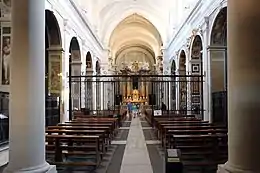
Mendelssohn composed three motets for women's voices inspired by a visit to Trinità dei Monti, the church at the top of the Spanish Steps in Rome, which he visited in 1830.[1] Having heard the nuns sing there, he wrote to his parents on 20 Dec 1830:
The French nuns sing there, and it is wonderfully lovely. ... Now, one should know one more thing: that one is not allowed to see the singers. Therefore I have come to an unusual decision: I will compose something for their voices, which I remember exactly[1]
He composed Veni Domine, Laudate pueri and O beata et benedicta the same year.[1][2] In the three motets published together in 1838, he replaced O beata et benedicta with the more substantial Surrexit pastor bonus.[2][3]
Structure
The titles of the three motets, Op. 39, are:
"Veni Domine" (Come, O Lord our God)[2] is a setting of a Latin verse for the Fourth Sunday in Advent. It is a setting in G minor for three voices (SSA) and organ. The duration is about 4 minutes.[7]
"Laudate pueri Dominum" (O ye that serve the Lord)[2] is a setting of two psalm verses, Psalm 113:2 and Psalm 128:1, in Latin. The first verse is set in E-flat major marked Allegro moderato assai, the second in A-flat major marked Adagio.[2] Both are scored for solo and choir voices (SSA) and organ. The motet takes about 6 minutes to perform.[7]
"Surrexit pastor bonus" (The Shepherd blest is risen)[2] is a setting of a Latin hymn for the Sunday of the Good Shepherd.[7] It is based on the reference to Jesus as the Good Shepherd in the Gospel of John (10:12,13,15).[6] Set in G major, it is written in four sections for four solo and choral voices (SSAA) and organ. The final section is an Alleluja building to eight voices.[2] The motet takes about 9 minutes to perform.[7]
Recordings
The motets were recorded in 2005 by the Kammerchor Stuttgart, conducted by Frieder Bernius, in volume 7 of a complete recording of Mendelssohn's sacred music in 10 volumes. A reviewer noted "the masterly singing of captivating reverence ... from the women of the Stuttgart choir".[2]
References
- "Felix Mendelssohn Bartholdy / Come, O Lord our God". Carus-Verlag. 2021. Retrieved 18 November 2021.
- Cookson, Michael (April 2009). "Felix Mendelssohn-Bartholdy (1809–1847) / Complete Sacred Choral Music". musicweb-international.com. Retrieved 24 November 2021.
- "Felix Mendelssohn Bartholdy / The shepherd blest is risen". Carus-Verlag. 2021. Retrieved 18 November 2021.
- Graulich, Günter, ed. (1977). "Veni Domine" (PDF). Carus-Verlag. Retrieved 18 November 2021.
- Graulich, Günter, ed. (1977). "Laudate pueri" (PDF). Carus-Verlag. Retrieved 18 November 2021.
- Graulich, Günter, ed. (1977). "Surrexit pastor bonus" (PDF). Carus-Verlag. Retrieved 18 November 2021.
- Roßbach, Judith (20 February 2020). "Felix Mendelssohn Bartholdy / Drei Motetten op. 39" (in German). Diocese of Cologne. Retrieved 24 November 2021.
External links
- 3 Motets, Op.39 (Mendelssohn, Felix): Scores at the International Music Score Library Project
- Veni Domine, Op. 39, No. 1 (Felix Mendelssohn): Free scores at the Choral Public Domain Library (ChoralWiki)
- Laudate pueri (Felix Mendelssohn): Free scores at the Choral Public Domain Library (ChoralWiki)
- Surrexit pastor bonus op. 39 No. 3 (Felix Mendelssohn): Free scores at the Choral Public Domain Library (ChoralWiki)
| Vocal |
| ||||||
|---|---|---|---|---|---|---|---|
| Orchestral |
| ||||||
| Chamber |
| ||||||
| Solo | |||||||
| People |
| ||||||
| Other | |||||||
| |||||||

