Chiba 11th district
Chiba 11th district (千葉県第11区, Chiba-ken dai-jūikku or simply 千葉11区, Chiba-jūikku) is a single-member constituency of the House of Representatives in the national Diet of Japan located in the eastern portion of Chiba Prefecture. After re-districting in 2022 the constituency covers six cities: Mobara, Tōgane, Katsuura, Isumi, Sanmu and Ōamishirasato, and three districts: Sanbu , Chōsei, and Isumi. The district was created in 1994 as part of an electoral reform effort in the Japanese House of Representatives, and was first implemented in the 1996 general election.
| Chiba 11th District | |
|---|---|
| Parliamentary constituency for the Japanese House of Representatives | |
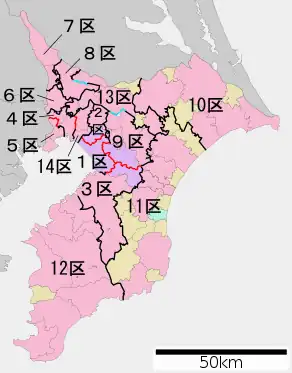 Numbered map of Chiba Prefecture single-member districts | |
| Prefecture | Chiba |
| Proportional District | Minamikantō |
| Electorate | 365,194 (2015)[1] |
| Current constituency | |
| Created | 1994 |
| Seats | One |
| Party | LDP |
| Representative | Eisuke Mori |
| Created from | Chiba's 3rd "medium-sized" district |
| Municipalities | Chiba's Mobara, Tōgane, Katsuura, Isumi, Sanmu, Ōamishirasato, Sanbu District, Chōsei District, and Isumi District |
As of 2015, this district was home to 365,194 constituents.[2]
List of representatives
| Representative | Party | Dates | Notes | |
|---|---|---|---|---|
| Eisuke Mori | LDP | 1996–present | ||
Election results
| Party | Candidate | Votes | % | ±% | |
|---|---|---|---|---|---|
| Liberal Democratic | Eisuke Mori (endorsed by Kōmeitō) | 110,538 | 64.4 |  4.4 4.4 | |
| Communist | Fumiaki Shiina | 30,557 | 17.8 | 4.0 | |
| Reiwa | Ryō Tagaya (won PR seat) | 30,432 | 17.7 | ||
| Turnout | 51.38 | 2.24 | |||
| Liberal Democratic hold | |||||
| Party | Candidate | Votes | % | ±% | |
|---|---|---|---|---|---|
| Liberal Democratic | Eisuke Mori (endorsed by Kōmeitō) | 103,919 | 60.0 |  3.1 3.1 | |
| Kibō no Tō | Ryō Tagaya | 45,345 | 26.2 | ||
| Communist | Fumiaki Shiina | 23,968 | 13.8 | 1.0 | |
| Turnout | 49.14 | 1.14 | |||
| Liberal Democratic hold | |||||
| Party | Candidate | Votes | % | ±% | |
|---|---|---|---|---|---|
| Liberal Democratic | Eisuke Mori (endorsed by Kōmeitō) | 110,965 | 63.14 | ||
| People's Life | Ken'ichi Kaneko | 38,783 | 22.07 | ||
| Communist | Fumiaki Shīna | 25,997 | 14.79 | ||
| Party | Candidate | Votes | % | ±% | |
|---|---|---|---|---|---|
| Liberal Democratic | Eisuke Mori (endorsed by Kōmeitō) | 128,785 | 65.04 | ||
| Tomorrow | Ken'ichi Kaneko (endorsed by NPD) | 48,114 | 24.30 | ||
| Communist | Fumiaki Shīna | 21,110 | 10.66 | ||
| Party | Candidate | Votes | % | ±% | |
|---|---|---|---|---|---|
| Liberal Democratic | Eisuke Mori (endorsed by Kōmeitō) | 116,937 | 49.7 | ||
| Democratic | Ken'ichi Kaneko (endorsed by PNP) (elected in PR block) | 112,707 | 47.9 | ||
| Happiness Realization | Tsukasa Kuga | 5,489 | 2.3 | ||
| Party | Candidate | Votes | % | ±% | |
|---|---|---|---|---|---|
| Liberal Democratic | Eisuke Mori (endorsed by Kōmeitō) | 145,176 | 62.65 | ||
| Democratic | Masahide Tsuchiya | 70,589 | 30.46 | ||
| Communist | Jūji Kobayashi | 15,968 | 6.89 | ||
| Party | Candidate | Votes | % | ±% | |
|---|---|---|---|---|---|
| Liberal Democratic | Eisuke Mori (endorsed by Kōmeitō, NCP) | 130,863 | 63.1 | ||
| Democratic | Hiroyuki Nagahama | 60,296 | 29.1 | ||
| Communist | Kyōko Maeda | 16,358 | 7.9 | ||
| Party | Candidate | Votes | % | ±% | |
|---|---|---|---|---|---|
| Liberal Democratic | Eisuke Mori | 135,151 | 66.4 | ||
| Democratic | Masahito Matsumoto | 45,465 | 22.3 | ||
| Communist | Yoshio Kogure | 23,064 | 11.3 | ||
| Party | Candidate | Votes | % | ±% | |
|---|---|---|---|---|---|
| Liberal Democratic | Eisuke Mori | 116,195 | 61.2 | ||
| New Frontier | Kouichi Hatsutani | 45,894 | 24.3 | ||
| Communist | Moriko Īmura | 21,954 | 11.6 | ||
| Liberal League | Naoko Hara | 4,600 | 2.4 | ||
References
- Ministry of Internal Affairs and Communications (MIC): (in Japanese)
- Ministry of Internal Affairs and Communications (MIC): (in Japanese)
- 小選挙区 千葉11区 (in Japanese). NHK. Retrieved 21 June 2023.
- 小選挙区 千葉11区 (in Japanese). NHK. Retrieved 21 June 2023.
- Data Sets (in Japanese). Asahi Shimbun. Retrieved 6 December 2016.
- Data Sets (in Japanese). Asahi Shimbun. Retrieved 6 December 2016.
- Data Sets (in Japanese). Yomiuri Shimbun. Retrieved 6 December 2016.
- Data Sets (in Japanese). Yomiuri Shimbun. Retrieved 6 December 2016.
- Data Sets (in Japanese). Election.co.jp. Retrieved 6 December 2016.
- Election 2000 (in Japanese). Election.co.jp. Archived from the original on 2 November 2003.
{{cite web}}: CS1 maint: bot: original URL status unknown (link) - 千葉県 (in Japanese). Kunitaka Tanaka. Archived from the original on 6 November 2016. Retrieved 19 April 2017.
This article is issued from Wikipedia. The text is licensed under Creative Commons - Attribution - Sharealike. Additional terms may apply for the media files.