Zagórze, Sosnowiec
Zagórze is the biggest, northernmost district of Sosnowiec, totally transformed with building the Huta Katowice (expanded, reached as far as Klimontów).
Zagórze | |
|---|---|
District of Sosnowiec | |
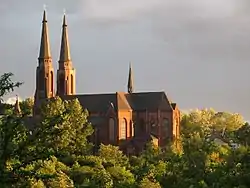 Saint Joachim Church | |
_COA.png.webp) Coat of arms | |
| Coordinates: 50°18′10″N 19°11′15″E | |
| Country |  Poland Poland |
| Voivodeship | Silesian |
| County/City | Sosnowiec |
| First mentioned | 1228 |
| Within city limits | 1975 |
| Time zone | UTC+1 (CET) |
| • Summer (DST) | UTC+2 (CEST) |
| Vehicle registration | SO |
| Primary airport | Katowice Airport |
History
In the 10th century, the area became part of the emerging Polish state under the Piast dynasty. In the 11th-12th century, there was a metallurgical settlement in which lead and silver were smelted.[1] The oldest known mention of Zagórze comes from a document from 1228. In the 14th century, a motte-and-bailey castle was built, and it is now an archaeological site.[1] Archaeologists discovered tools from the Stone Age at the site.[1] In the following centuries, Zagórze was a private village of Polish nobility, including the Jarocki and Mieroszewski families.[2] There is a Neoclassical palace of the Mieroszewski family in Zagórze.
In 1827, it had a population of 457, which grew to 721 until the late 19th century.[2] In 1842 a zinc smelter was established in Zagórze.[2]
In 1975, Zagórze was included within the city limits of Sosnowiec as its new district. Before that, it was a separate town in Będzin County.
References
- Michał Bugaj. "Gródek stożkowaty". Zabytek.pl (in Polish). Retrieved 25 July 2021.
- Słownik geograficzny Królestwa Polskiego i innych krajów słowiańskich, Tom XIV (in Polish). Warszawa. 1895. p. 265.
{{cite book}}: CS1 maint: location missing publisher (link)