Trachypepla spartodeta
Trachypepla spartodeta is a moth of the family Oecophoridae first described by Edward Meyrick in 1883.[1] It is endemic to New Zealand and has been collected in both the North and South Islands. This species inhabits native forest and adults are on the wing from November to January.
| Trachypepla spartodeta | |
|---|---|
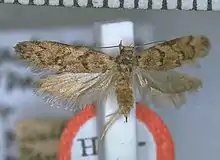 | |
| Female holotype | |
Scientific classification  | |
| Domain: | Eukaryota |
| Kingdom: | Animalia |
| Phylum: | Arthropoda |
| Class: | Insecta |
| Order: | Lepidoptera |
| Family: | Oecophoridae |
| Genus: | Trachypepla |
| Species: | T. spartodeta |
| Binomial name | |
| Trachypepla spartodeta | |
Taxonomy
This species was first described by Edward Meyrick in 1883 using a specimen collected in Wellington in January.[2][3] A fuller description of this species was given by Meyrick in 1884.[3] George Hudson discussed and illustrated this species in his 1928 book The butterflies and moths of New Zealand.[4] The female holotype, collected in the Wellington Botanic Garden, is held at the Natural History Museum, London.[5]
Description
.jpg.webp)
Meyrick described this species as follows:
Female. — 15 mm. Head and palpi pale greyish-ochreous, terminal joint of palpi with two obscure dark fuscous rings, second joint obscurely banded with dark fuscous. Antennae fuscous. Thorax pale greyish-ochreous, mixed with dark fuscous. Abdomen grey. Anterior and middle legs dark fuscous, with pale greyish-ochreous rings at apex of joints ; posterior legs whitish-ochreous, slightly infuscated. Forewings elongate, rather narrow, costa moderately arched, apex nearly pointed, hindmargin hardly rounded, very oblique ; greyish-ochreous, somewhat mixed with dark fuscous ; markings cloudy dark fuscous ; a small spot at base of costa, and another on inner margin near base ; a transverse line from 1⁄4 of costa to 1⁄3 of inner margin, forming a right angle outwards in disc, where it is mixed with ferruginous, and preceded near inner margin by a tuft of raised scales ; a narrow elongate spot along central third of costa, connected with a raised ferruginous spot in middle of disc, beneath which is a raised tuft and some irregular dark fuscous spots ; a transverse line proceeding from costa at 4⁄5 obliquely inwards, a little beneath costa sharply bent outwards, and thence curved to anal angle; three or four small cloudy marginal spots round apex: cilia pale greyish-ochreous, mixed with dark fuscous. Hindwings pale grey, apex and hindmargin darker ; cilia grey- whitish, with two faint grey lines.[3]
This species is variable in the intensity and depth of its general colouration as well as in the markings on its forewings.[4]
Distribution
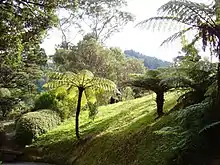
This species is endemic to New Zealand and has been collected in Wellington as well as in Taupo, Dunedin and Southland.[6][7] Hudson was of the opinion that this species was rather rare.[4]
Habitat
This species inhabits native forest.[4]
Behaviour
The adults of this species are on wing from November until January.[8]
References


- Gordon, Dennis P., ed. (2010). New Zealand inventory of biodiversity: Kingdom animalia : chaetognatha, ecdysozoa, ichnofossils. Vol. 2. p. 462. ISBN 978-1-877257-93-3. OCLC 973607714. OL 25288394M. Wikidata Q45922947.
- Edward Meyrick (September 1883). "Descriptions of New Zealand Micro-Lepidoptera.—III.—Oecophoridae". New Zealand Journal of Science. 1: 522. Wikidata Q106368126.
- Edward Meyrick (1884). "Descriptions of New Zealand Microlepidoptera. III. Oecophoridae". Transactions and Proceedings of the New Zealand Institute. 16: 16. ISSN 1176-6158. Wikidata Q63976486.
- George Vernon Hudson (1928), The butterflies and moths of New Zealand, Illustrator: George Hudson, Wellington, p. 285, LCCN 88133764, OCLC 25449322, Wikidata Q58593286
{{citation}}: CS1 maint: location missing publisher (link) - John Stewart Dugdale (23 September 1988). "Lepidoptera - annotated catalogue, and keys to family-group taxa". Fauna of New Zealand. Department of Scientific and Industrial Research. 14: 107. doi:10.7931/J2/FNZ.14. ISSN 0111-5383. Wikidata Q45083134.
- "Trachypepla spartodeta Meyrick, 1883". www.nzor.org.nz. Retrieved 2022-05-03.
- "Trachypepla spartodeta". www.aucklandmuseum.com. 2022. Retrieved 30 July 2022.
- "Trachypepla spartodeta Meyrick, 1884". www.gbif.org. Retrieved 2022-07-29.